Licence, regulation and player protection
SkyHills Casino Licence & Safety: UKGC, GAMSTOP and Trust Checks
 Available in GB
SkyHills should not be treated as holding a UK Gambling Commission licence. For consumers in Great Britain, that is important because remote gambling operators serving England, Scotland and Wales require the appropriate UKGC operating licence. The position should not be expanded into a blanket statement about every part of the United Kingdom, and it does not establish whether an individual account can be opened from a particular location.
GAMSTOP ONLINE belongs to the UKGC-regulated online market. SkyHills should not be described here as a GAMSTOP member or as a UKGC-licensed casino. Its own safer-gambling tools and KYC requirements are separate product features, while Northern Ireland has a distinct gambling-law framework.
Table of Contents
- SkyHills and the UK Gambling Commission
- Great Britain position
- Why the Great Britain licence requirement matters
- Great Britain and Northern Ireland use different gambling frameworks
- GAMSTOP applies within the UKGC online regime
- SkyHills describes its own safer-gambling controls
- KYC is part of the SkyHills withdrawal process
- Copycat and lookalike pages can conflict with SkyHills details
- A five-step SkyHills licence and safety check
- SkyHills account controls and the Great Britain framework
- What the Great Britain licence position means for SkyHills
SkyHills and the UK Gambling Commission
SkyHills should not be treated as holding a UKGC operating licence for Great Britain. The Gambling Commission business register is the public record used for licensed gambling businesses in Great Britain.
For consumers in England, Scotland and Wales, the Great Britain licensing position for SkyHills means the brand should not be presented as UKGC-regulated. It also means that international product pages, British-facing search results or a .uk domain used by a third party do not establish Great Britain licensing.
Great Britain position
- Regulator: UK Gambling Commission.
- Territory: England, Scotland and Wales.
- SkyHills: SkyHills should not be treated as UKGC-licensed.
- UK player acceptance and GAMSTOP membership should not be assumed from the international product.
Why the Great Britain licence requirement matters
The Gambling Commission’s remote gambling guidance states that a business needs a Gambling Commission licence if it provides remote gambling to consumers in Great Britain, even when the business is based abroad.
That requirement covers England, Scotland and Wales and applies to online casino activity such as slots, roulette and blackjack. A casino’s international availability, payment menu or game catalogue is not a substitute for the operating status required to serve that market.
SkyHills can therefore be described as an international casino product without being described as UKGC-licensed. The main SkyHills review covers the wider product while keeping the Great Britain licensing position separate.
Great Britain and Northern Ireland use different gambling frameworks
The Gambling Commission states that its Gambling Act jurisdiction covers Great Britain – England, Scotland and Wales – and not gambling activity in Northern Ireland, apart from specific UK-wide responsibilities such as the National Lottery.
Northern Ireland therefore should not be folded into a single Great Britain licensing statement. A UKGC operating-licence rule that applies to serving consumers in Great Britain is not automatically a description of Northern Ireland’s separate gambling-law framework.
For readers, the key point is territorial: UKGC licensing is the central remote-gambling issue for England, Scotland and Wales, while Northern Ireland must be considered under its own framework.
GAMSTOP applies within the UKGC online regime
The Gambling Commission requires online gambling businesses within the relevant Great Britain licensing regime to participate in GAMSTOP ONLINE, the national multi-operator self-exclusion scheme.
SkyHills should not be treated as a UKGC licensee or as a GAMSTOP member. It should also not be marketed as a “non-GAMSTOP casino for UK players”, because that phrase would turn the Great Britain licensing position into an unsupported claim about UK player access.
GAMSTOP and a casino’s own self-exclusion setting are different mechanisms. GAMSTOP covers multiple participating online operators; an account-level self-exclusion tool applies within the operator’s own service.
SkyHills describes its own safer-gambling controls
SkyHills describes deposit and loss limits, session or reality checks, cooling-off options and self-exclusion. These controls can help a customer set boundaries within the SkyHills account.
They do not establish UKGC licensing or GAMSTOP participation. An operator can provide account-level safer-gambling controls without those controls answering the separate question of whether the operator is licensed to serve consumers in Great Britain.
The mobile verification covers how the product is delivered on phones and tablets. Mobile compatibility likewise does not change the licensing position.
KYC is part of the SkyHills withdrawal process
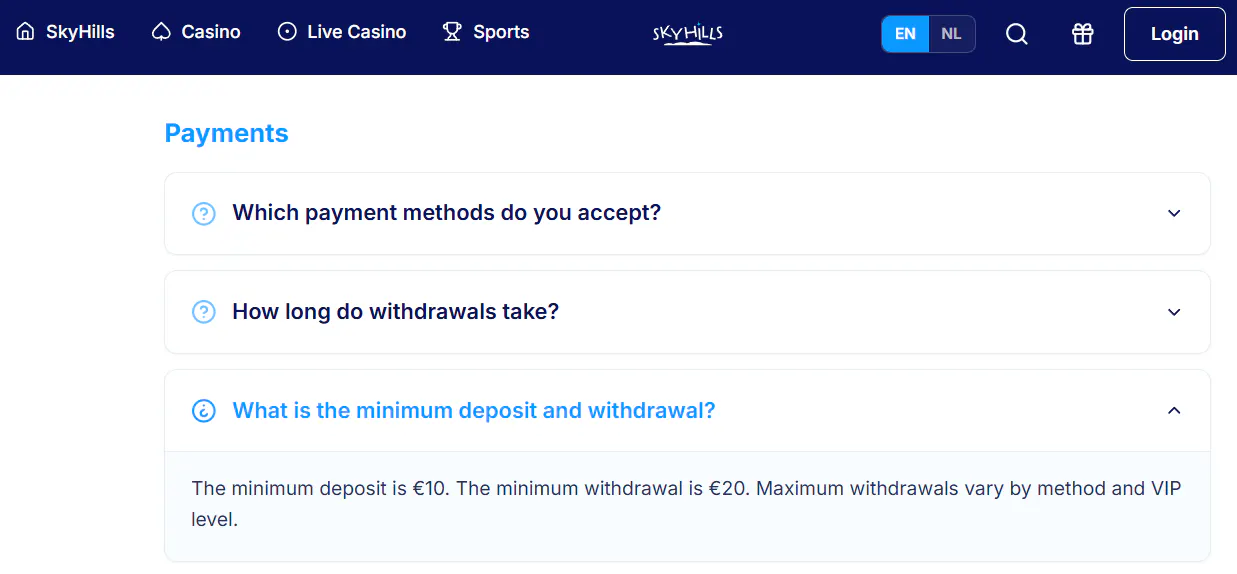
SkyHills states that identity checks must be completed before withdrawals are processed. The current FAQ also gives a 24-hour processing statement after KYC and lists a EUR 20 minimum withdrawal.
SkyHills does not describe one fixed KYC document list for every customer. Account circumstances can affect what information is requested, so the requirements shown for the individual account take priority.
The detailed SkyHills withdrawals and KYC guide explains the payout sequence. General funding categories and Great Britain credit-card restrictions are covered on the payment methods page.
Copycat and lookalike pages can conflict with SkyHills details
SkyHills-branded pages outside the main skyhills.com service make inconsistent claims about licensing, payments and mobile apps. A matching brand name in a domain or page title is therefore not enough to establish the regulatory status of the casino. For a Great Britain customer, the relevant local status comes from the Gambling Commission’s public business register and the licence information connected to the operator serving that market.
This distinction is especially important when a third-party page supplies a licence number, company name, office address or app download that does not appear on the main SkyHills service. Conflicting details should not be combined into a single profile. SkyHills’ casino features can be discussed from its own site, while Great Britain licensing must be treated according to the UKGC regime.
A five-step SkyHills licence and safety check
For Great Britain, the first question is whether the casino is licensed by the Gambling Commission to provide remote gambling to consumers in England, Scotland and Wales. SkyHills should not be treated as UKGC-licensed. That position also means the site should not be described as a GAMSTOP participant, because GAMSTOP ONLINE participation is tied to businesses in the UKGC online regime.
SkyHills does describe its own account controls, including deposit limits, loss limits, session or reality checks, cooling-off options and self-exclusion. Those controls can help a customer manage activity on the SkyHills account, but they are not the same thing as the Great Britain multi-operator self-exclusion system. A local casino control applies within that casino; GAMSTOP blocks access across participating licensed online operators.
KYC is another separate control. SkyHills says identity checks are required before withdrawals are processed. The exact documents and completion time can depend on the account and circumstances. The payout and KYC guide covers how the KYC stage connects to the operator’s stated withdrawal-processing time.
SkyHills account controls and the Great Britain framework
SkyHills describes several controls that a customer can use within the casino account. Deposit limits can cap how much is added to the account, while loss limits can restrict net losses over the chosen period. Session or reality checks are designed to interrupt continuous play with time or activity reminders. Cooling-off and self-exclusion options provide stronger breaks from gambling activity.
These controls are relevant to the way SkyHills manages its own customer relationship, but they should not be confused with the protections attached to a Great Britain operating licence. The UKGC regime sets requirements for licensed businesses that serve consumers in England, Scotland and Wales. GAMSTOP ONLINE is one part of that framework, because licensed online businesses in the regime must participate in the national multi-operator self-exclusion scheme.
The practical difference is scope. A SkyHills account limit applies to activity on that account. A multi-operator scheme is designed to block access across participating businesses. This is why the presence of account controls cannot be used to infer GAMSTOP membership, and the SkyHills Great Britain licensing position cannot be turned into a claim that SkyHills is a recognised Great Britain “non-GAMSTOP” option.
KYC sits alongside these controls for a different reason. SkyHills requires identity checks in connection with withdrawals. KYC can affect when a payout reaches the operator-processing stage, but it is not a substitute for a gambling licence and does not establish which countries are eligible to open accounts. The casino’s account controls, its payout checks and the Great Britain licensing framework should therefore be treated as three separate parts of the customer picture.
For customers comparing account protections, the order of importance is therefore straightforward: Great Britain authorisation is a regulatory question, GAMSTOP is a multi-operator scheme within that regulated online market, and SkyHills’ own limits and self-exclusion tools apply at casino-account level. KYC has a fourth role, connecting identity checks to account and withdrawal handling rather than to the existence of a Great Britain licence.
For Great Britain, the licence question therefore remains decisive even when the casino has normal account controls. Safer-gambling tools can reduce risk within an account, and KYC can support account security and withdrawals, but neither feature gives SkyHills permission to serve consumers in England, Scotland or Wales.
What the Great Britain licence position means for SkyHills
For a Great Britain reader, the key point is that SkyHills should not be treated as a UKGC-licensed remote casino. The Gambling Commission requires the appropriate operating licence when a remote gambling business serves consumers in England, Scotland or Wales. Product features such as slots, live casino, a sportsbook, promotions, browser play or payment categories do not substitute for that local authorisation.
The position should also remain geographically precise. Northern Ireland is not regulated by the Gambling Commission in the same way as Great Britain, so a statement about the UKGC regime should not be expanded into a blanket claim covering every part of the United Kingdom. Likewise, the SkyHills Great Britain licensing position does not justify inventing a different offshore licence number or company identity.
GAMSTOP follows the same boundary. Businesses operating under the UKGC online regime are required to participate in GAMSTOP ONLINE, but SkyHills should not be labelled either a GAMSTOP member or a “non-GAMSTOP casino for UK players”. The latter wording can wrongly suggest that the casino is a Great Britain-facing alternative to the regulated system.
SkyHills’ own safer-gambling controls still matter at product level. Deposit and loss limits, session checks, cooling-off and self-exclusion can help manage an account, and KYC is part of the withdrawal flow. They are useful controls, but they do not change the Great Britain licensing position. The payment methods and bonus eligibility pages apply the same separation to cashier options and promotions.
Published by the Skyhills Casino team.